lgtmaybe
lgtmaybe reviews pull and merge requests on GitHub, GitLab, Gitea, and Azure DevOps, posting inline comments and one summary. Choose a hosted model, ollama, or another OpenAI-compatible endpoint.
It works before a pull request exists. Run lgtmaybe review on your
branch, add a pre-commit hook, or
hand its findings to your coding agent
to fix. With a local model, your code stays local.
It reads the diff plus a little surrounding code and comments only on changed lines. It never checks out or runs the change, skips generated files and binaries, redacts secrets, and treats author-supplied text as untrusted.
It checks for:
- Correctness and security: logic errors, missed
awaits, injection, auth mistakes, and leaked secrets. - Code health: performance problems, needless complexity, deprecations, and risky dependencies.
- Tests and documentation: missing or weak tests, stale comments, and undocumented APIs.
- Intent: whether the change does what its title, description, and commits say.
- Ponytail: code you don't need, and simpler or standard-library ways to do the job.
- Architecture: coupling, wrong-way dependencies, and broken subclass contracts that will be hard to undo.
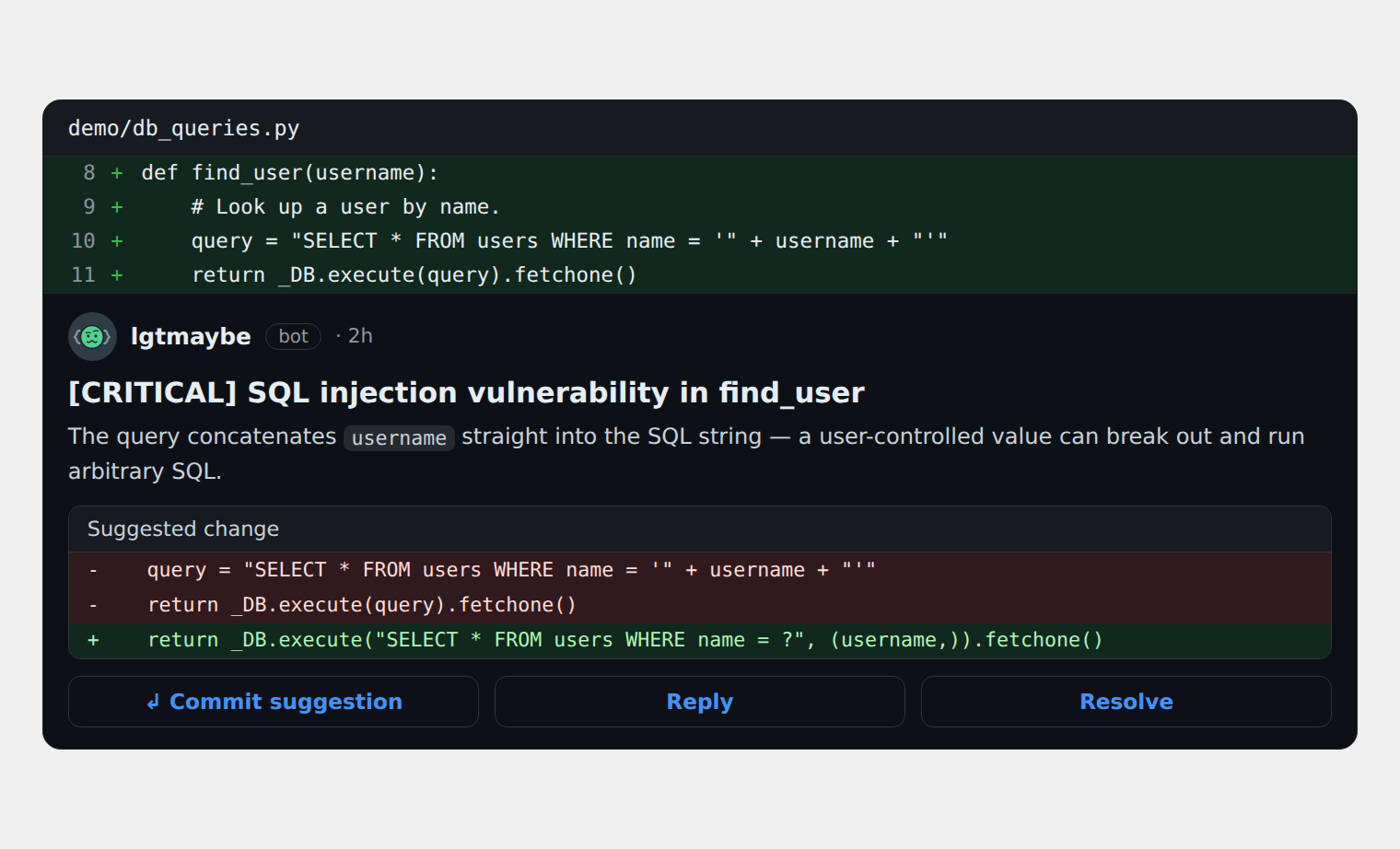
Each finding is graded info to critical
and lands on its changed line. A clean change gets a 👍 LGTM!.
Slash commands refresh a review (/review, /improve), answer a question
(/ask), or post a description (/describe) or
change overview (/diagram). The
overview rates the risk of change, lists high-impact areas, and draws a
flowchart, plus a sequence diagram when the change alters a runtime flow.
lgtmaybe diagram prints a text version locally.
flowchart LR
    web["Storefront<br/>React<br/>places orders"]
    api["Order API<br/>Python<br/>creates orders (changed)"]
    db["Order database<br/>PostgreSQL<br/>stores orders"]
    queue["Order events<br/>SQS<br/>buffers events (new)"]
    worker["Notification worker<br/>Python<br/>sends confirmations (new)"]
    email["Email provider<br/>delivers messages"]
    web -->|calls| api
    api -->|stores in| db
    api -->|publishes to| queue
    queue -->|delivers to| worker
    worker -->|sends via| email
Start here
- Tutorial: Getting started: your first review with ollama, locally and free.
- How-to: install the CLI, choose a review model, run locally, Bedrock OIDC, Vertex WIF, Azure OpenAI, GitHub Action, GitLab, Gitea, Forgejo, Azure DevOps.
- Reference: Configuration: every config field and schema.
- Explanation: What gets reviewed, Architecture, Auth model, Data & privacy.
What's New
- 2.15.2 · 2026-10-17 · ci: wait out PyPI index lag and winget token quota on release
- 2.15.1 · 2026-10-17 · ci: pin the tap checkout branch so it skips the REST API
- 2.15.0 · 2026-10-17 · gitea: resolve fixed findings' comments on Gitea 1.26+; provider: review with a ChatGPT subscription; and 3 more changes
- 2.14.0 · 2026-10-16 · forgejo: keyless Bedrock, Azure and Vertex from a runner's OIDC token; forgejo: review Forgejo pull requests from Forgejo Actions; and 25 more changes
- 2.13.0 · 2026-10-16 · engine: add architecture review lens; engine: arbitrate opposing findings and refresh ponytail lens for ponytail 5; and 5 more changes
Providers
| Provider | Auth |
|---|---|
openai |
OPENAI_API_KEY |
anthropic |
ANTHROPIC_API_KEY |
openrouter |
OPENROUTER_API_KEY |
zai |
ZAI_API_KEY for GLM / Zhipu AI; optional --api-base for the China / coding-plan endpoint |
chatgpt |
A ChatGPT Plus or Pro subscription, signed in with lgtmaybe login chatgpt; local reviews only |
bedrock |
Ambient AWS creds via GitHub OIDC, no static key |
vertex |
Ambient GCP creds via Workload Identity Federation, no key |
azure |
Resource endpoint, plus AZURE_API_KEY or keyless Entra (Azure AD) creds via GitHub OIDC |
ollama |
None: local only, zero cost |
openai-compatible |
--api-base to any OpenAI /v1 endpoint; key optional (placeholder for keyless local servers) |